Home » Treatment » Nalcrom (sodium cromoglycate) 100mg capsules
Nalcrom (sodium cromoglycate) 100mg capsules
from£99.99
Nalcrom (sodium cromoglycate) 100mg capsules stabilise mast cells to help prevent food-related allergic symptoms and some gut problems linked to MCAS. You take Nalcrom regularly before meals to lower the risk and severity of reactions, following advice from your allergy or gastroenterology specialist.
Nalcrom (sodium cromoglycate) 100mg capsules are a prescription-only medication. It can help prevent symptoms triggered by food allergy and certain mast cell–mediated gut problems [1],[2].
Rather than treating a reaction once it has started, it works in the background. Nalcrom calms mast cells and reduce their tendency to release histamine and other inflammatory chemicals when you eat [6].
Take the capsules several times a day before meals. For many people, this fits into a regular routine: breakfast, lunch, evening meal and sometimes bedtime [1],[2]. Your prescriber may adjust the dose based on your age, weight, and the severity of your symptoms.
Nalcrom capsules are often used as part of a broader treatment plan. Other options includecareful food avoidance and antihistamines [3], [4]. It is one part of a broader strategy rather than a stand?alone cure.
Typical features
Capsule containing 100 mg sodium cromoglycate
Taken before meals, usually several times a day
Used for food allergy–related gut symptoms and selected mast cell–driven conditions under specialist care
Additional information
Quantity
1 x 100, 2 x 100, 3 x 100, 4 x 100, 5 x 100
MOJO WISDOM
Take control of your health by understanding your condition and what this medication is doing for you.
Nalcrom (sodium cromoglycate) 100mg capsules are a preventive medicine used to reduce symptoms of food allergy and some mast cell–related gut conditions. It works by calming down mast cells in the gut so they are less likely to release histamine and other inflammatory chemicals when you eat trigger foods [1].
It is usually taken several times a day before meals and can be prescribed for adults and children under specialist supervision [2].
This guide walks through what Nalcrom (sodium cromoglycate) 100mg capsules are for, how they work, how to take them safely, and what to expect in day-to-day life.
Key takeaways
Nalcrom (sodium cromoglycate) 100mg capsule is a mast cell stabiliser used to prevent food-related allergic symptoms and selected mast cell–mediated gut conditions [1],[2], [3].
It is taken regularly before meals and works best as a long-term preventative treatment rather than a quick fix [3], [4].
The medicine does not replace emergency treatments such as adrenaline (epinephrine) for anaphylaxis, and avoidance of known allergens is still essential [5].
Side effects are usually mild but can include nausea, abdominal discomfort, skin rash or joint pains; serious reactions are rare [1], [2].
Ongoing review with a healthcare professional helps to fine-tune the dose, monitor benefit, and decide how Nalcrom (sodium cromoglycate) 100mg capsule fits into your wider allergy or MCAS management plan [3], [4].
Nalcrom (sodium cromoglycate) 100mg capsules have been used for many years as a preventive option for food allergy–related gut symptoms. It sits in an interesting space: not a classic antihistamine, not a steroid, but a mast cell stabiliser that tries to stop the reaction at its source [1], [2].
For people living with complex mast cell conditions, such as mast cell activation syndrome or mastocytosis, the gut can be a major trouble spot [3], [4]. Meals that should be enjoyable become a game of “will this set things off?”
Nalcrom (sodium cromoglycate) 100mg capsules are often used as part of a layered approach that may also include antihistamines, dietary changes, and, in some cases, other mast cell–targeted therapies [3], [4].
Because it is preventive, Nalcrom (sodium cromoglycate) 100mg capsules require a bit of planning. Doses are usually timed before meals, and benefit tends to build gradually. Many patients describe it as “raising the threshold” for reactions rather than completely switching them off. That can still be life-changing, especially when accidental exposures are hard to avoid [3], [4].
Evidence from clinical practice and guideline documents suggests that sodium cromoglicate can reduce gastrointestinal symptoms in selected patients with food allergy or mast cell–driven gut disease, particularly when other measures alone are not enough [3], [4]. As with most allergy treatments, response varies, so regular review with your specialist is important.
Active ingredient in Nalcrom (sodium cromoglycate) 100mg capsule
Each Nalcrom (sodium cromoglycate) 100mg capsule contains 100 mg of sodium cromoglycate, a mast cell–stabilising medicine [1], [2]. The capsule shell and other ingredients may vary slightly between manufacturers, so always check the patient information leaflet if you have allergies to excipients such as lactose or colouring agents [1], [2].
Sodium cromoglicate belongs to a small group of medicines that help prevent mast cells from releasing histamine and related inflammatory mediators. It is not a steroid and does not work like an antihistamine; instead, it acts earlier in the allergic cascade [6].
What is Nalcrom (sodium cromoglycate) 100mg capsule for?
Nalcrom (sodium cromoglycate) 100mg capsule is licensed for the management of food allergy affecting the gastrointestinal tract, where careful assessment has shown that certain foods trigger symptoms [3], [4].
These symptoms can include:
abdominal pain,
diarrhoea,
nausea,
vomiting, or
general discomfort after eating particular foods.
In UK practice, sodium cromoglicate capsules are often considered when standard measures such as strict avoidance, dietary support, and antihistamines have not been enough, particularly when symptoms are frequent or severe [1], [2].
Specialists may also use Nalcrom (sodium cromoglycate) 100mg capsule off-label for certain mast cell–related gut conditions, such as mast cell activation syndrome or systemic mastocytosis with prominent gastrointestinal symptoms, as part of a broader treatment plan [3], [4]. This is usually done in secondary or tertiary care with careful monitoring.
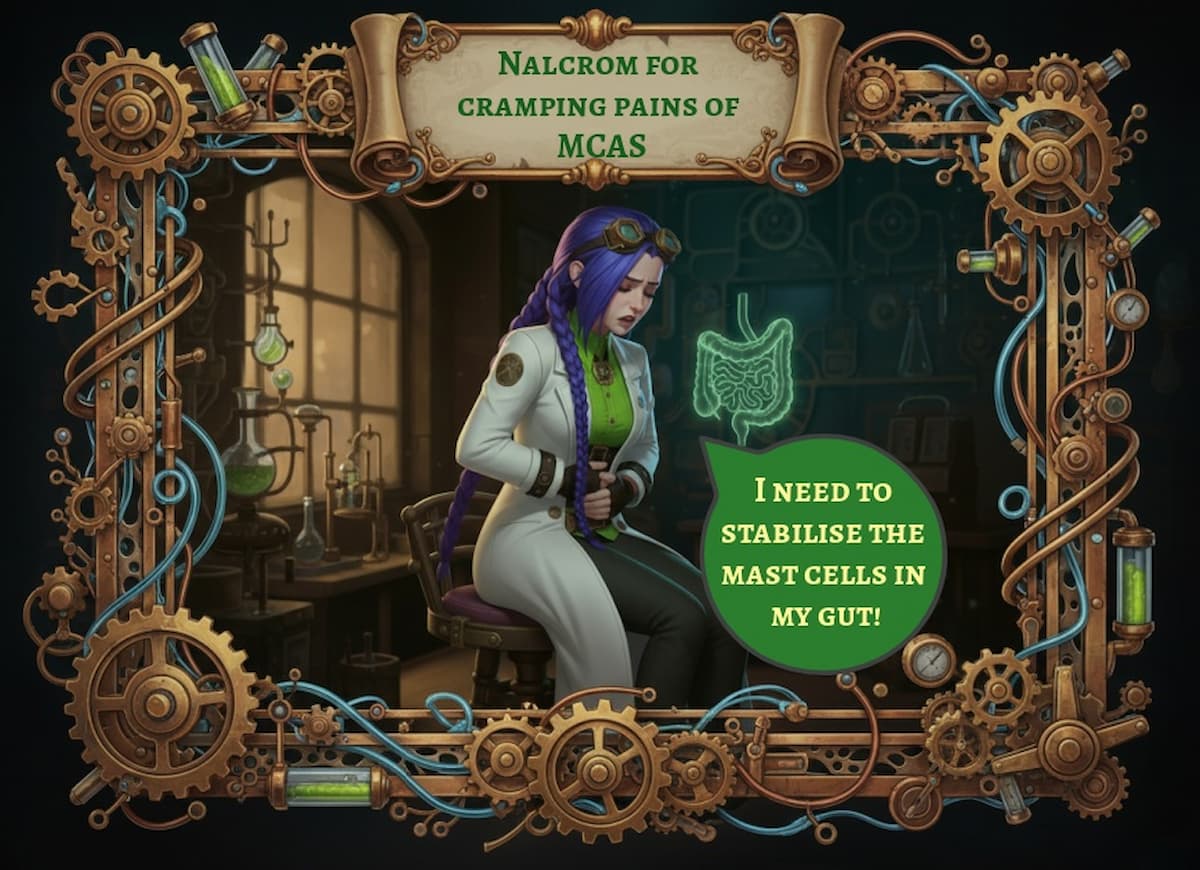
Oral sodium cromoglycate is sometimes used when people with <a href="https://medicalmojo.co.uk/conditions/mast-cell-activation-syndrome/">MCAS still have ongoing gut symptoms – such as cramping and diarrhoea – even though they are already taking H1 and H2 antihistamines.
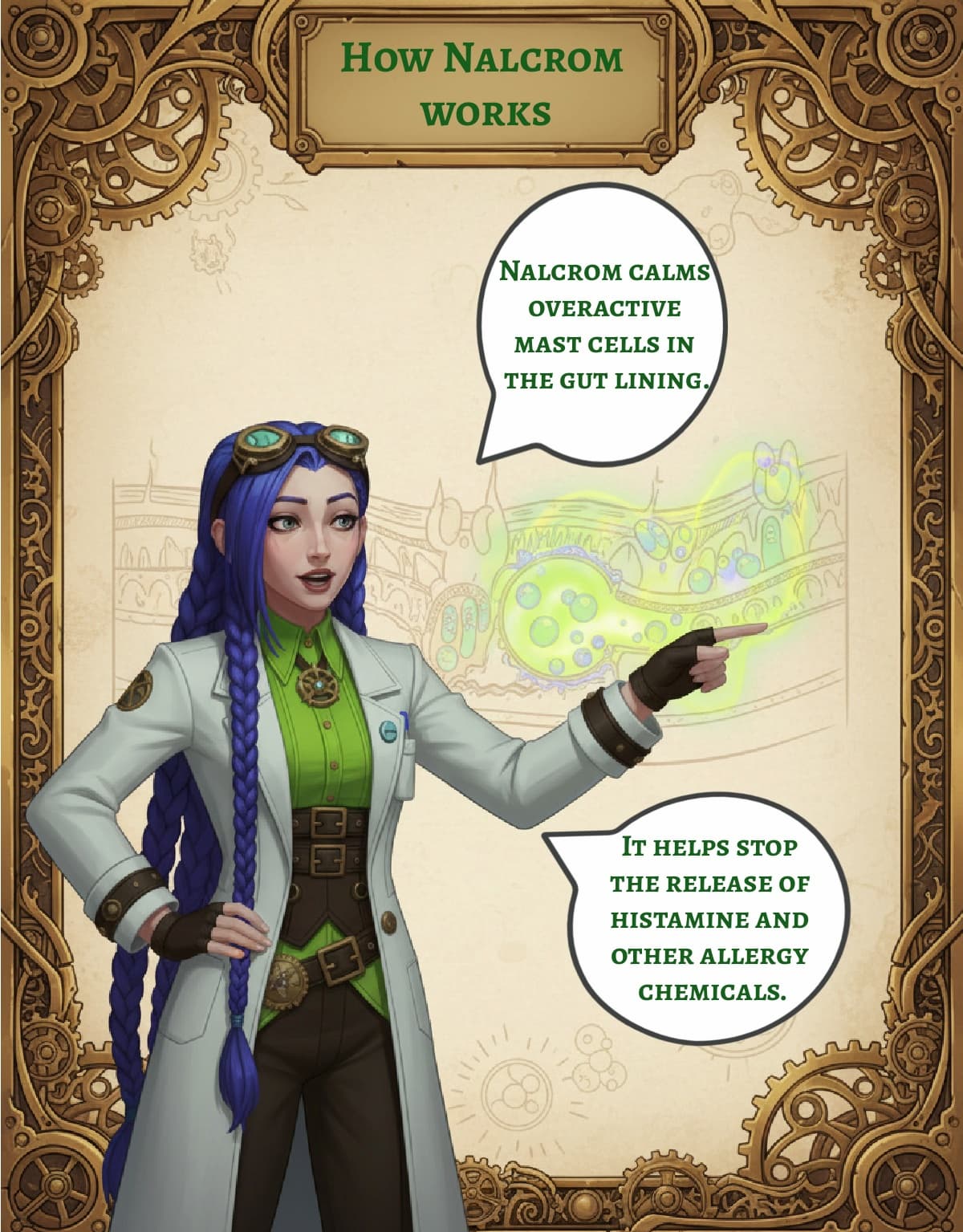
We still do not fully understand how oral sodium cromoglycate works, but it is thought to help by stabilising mast cells in the gut, making them less likely to release histamine and other inflammatory chemicals [6].
Most of the evidence we have comes from a very small study in 11 people with systemic mastocytosis. In that trial, cromolyn clearly reduced abdominal pain and diarrhoea compared with placebo, but it did not make much difference to symptoms outside the digestive system. The study also included only people who had already done well on cromolyn, so the results are likely to look more positive than they might in a broader group [7].
When taken by mouth, cromolyn is only minimally absorbed into the bloodstream and is usually well tolerated [8]. Specialists often recommend starting with a low dose and gradually increasing to a typical target dose of 200 mg four times a day. It is usually taken on an empty stomach, before meals and again at bedtime.
How does Nalcrom (sodium cromoglycate) 100mg capsule work?
To understand Nalcrom (sodium cromoglycate) 100mg capsules, picture mast cells as tiny alarm systems dotted along your gut lining. When they sense an allergen, they are triggered and “degranulate,” releasing chemicals, including histamine and a cocktail of other substances that cause swelling, pain, diarrhoea, and general misery [6].
Sodium cromoglicate works by stabilising the membrane of these mast cells, making them less likely to “degranulate” and release their contents when triggered [6]. It does not eliminate the allergy, but it can reduce the strength of the mast cell reaction.
MC stabilising medicines like sodium cromoglycate are designed to calm those alarms down so they’re less likely to go off.
Mast cell stabilisers
Scientists describe three main ways these mast cells stabilising medicines can work:
They can block the outside signals that would usually switch mast cells on.
They can interfere with the signalling inside the mast cell, so the “fireworks” never start.
They can directly stop or reduce degranulation – the moment when mast cells release their chemical contents.
Sodium cromoglycate, the best-known mast cell stabiliser
One of the best-known mast cell stabilisers is cromolyn (sodium cromoglycate). It was first made in the 1960s while researchers were working with a plant-based heart medicine called khellin [6]. Cromolyn or sodium cromoglycate turned out to be very good at calming mast cells, so it became a medicine in its own right.
How does sodium cromoglycate work?
Sodium cromoglycate or Nalcrom works mainly by attaching to a calcium-binding protein on the surface of mast cells. Calcium is one of the key signals that tells a mast cell to degranulate. When sodium cromoglycate forms a complex with this protein and calcium, it effectively blocks that signal and helps stabilise the mast cell membrane, making it less likely to burst and release histamine [6].
Sodium cromoglycate and the GPR35 receptor
More recently, researchers have found that sodium cromoglycate can also act on a receptor called GPR35, which is found in high amounts in the gut and has been linked to inflammatory bowel disease [6].
When GPR35 is switched on, it can change how ions move across the cell membrane and briefly lower calcium levels inside the cell [6]. That might be another way sodium cromoglycate helps calm inflammation in the digestive system [6]. However, this idea doesn’t fully align with earlier studies and still needs further research to confirm exactly what is happening.
Where does sodium cromoglycate act in the body?
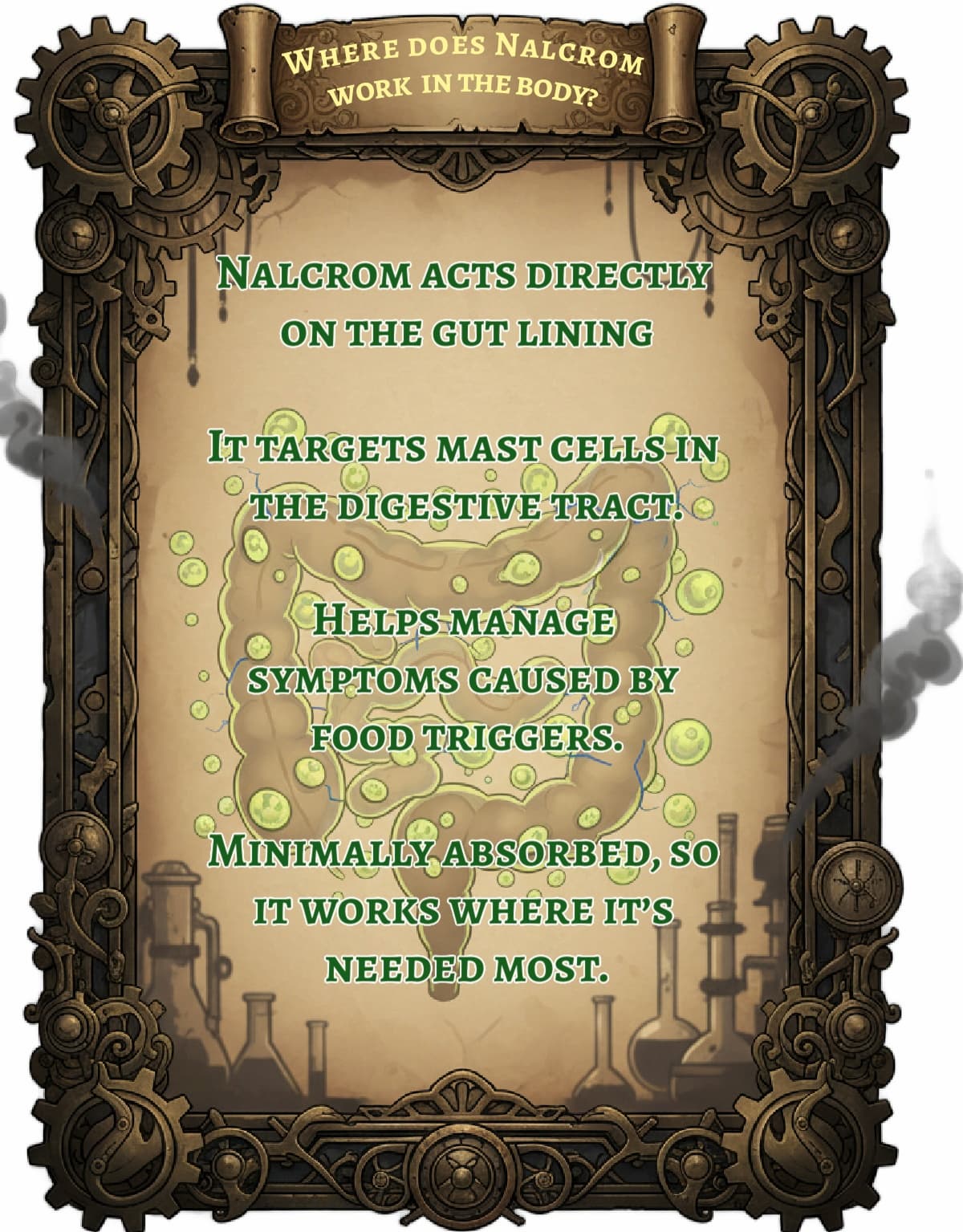
When you take Nalcrom (sodium cromoglycate) 100mg capsules before meals, the medicine acts locally in the gut [8]. Only a small amount is absorbed into the bloodstream, which is one reason systemic side effects are relatively uncommon [8].
Regular dosing with sodium cromoglycate raises the mast cell activation threshold
Over time, regular dosing can raise the threshold at which your mast cells react. That might mean fewer flares, milder symptoms when you do respond, or a bit more flexibility around foods that previously caused trouble. It is not usually an overnight change; many people notice gradual improvement over days to weeks [3], [4].
How to use Nalcrom (sodium cromoglycate) 100mg capsules
Take Nalcrom (sodium cromoglycate) 100mg capsule exactly as prescribed. The general principles below are based on clinical references and patient information leaflets [1], [2].
First, timing matters. Capsules are usually taken 15–30 minutes before meals and sometimes at bedtime. Setting phone reminders or pairing doses with daily habits (like making a cup of tea) can help keep things consistent.
Second, swallow the capsules whole with water unless your doctor or pharmacist has advised another method. Some protocols allow the capsule to be opened and the contents mixed with a small amount of water for people who struggle with swallowing, but this should follow the guidance in your leaflet or from your specialist [1], [2].
If you miss a dose, take it when you remember, unless it is almost time for your next one. In that case, skip the missed dose and continue as usual. Do not double up to “catch up”, as this does not improve control and may increase side effects [1], [2].
Warnings and precautions: Nalcrom (sodium cromoglycate) 100mg capsules
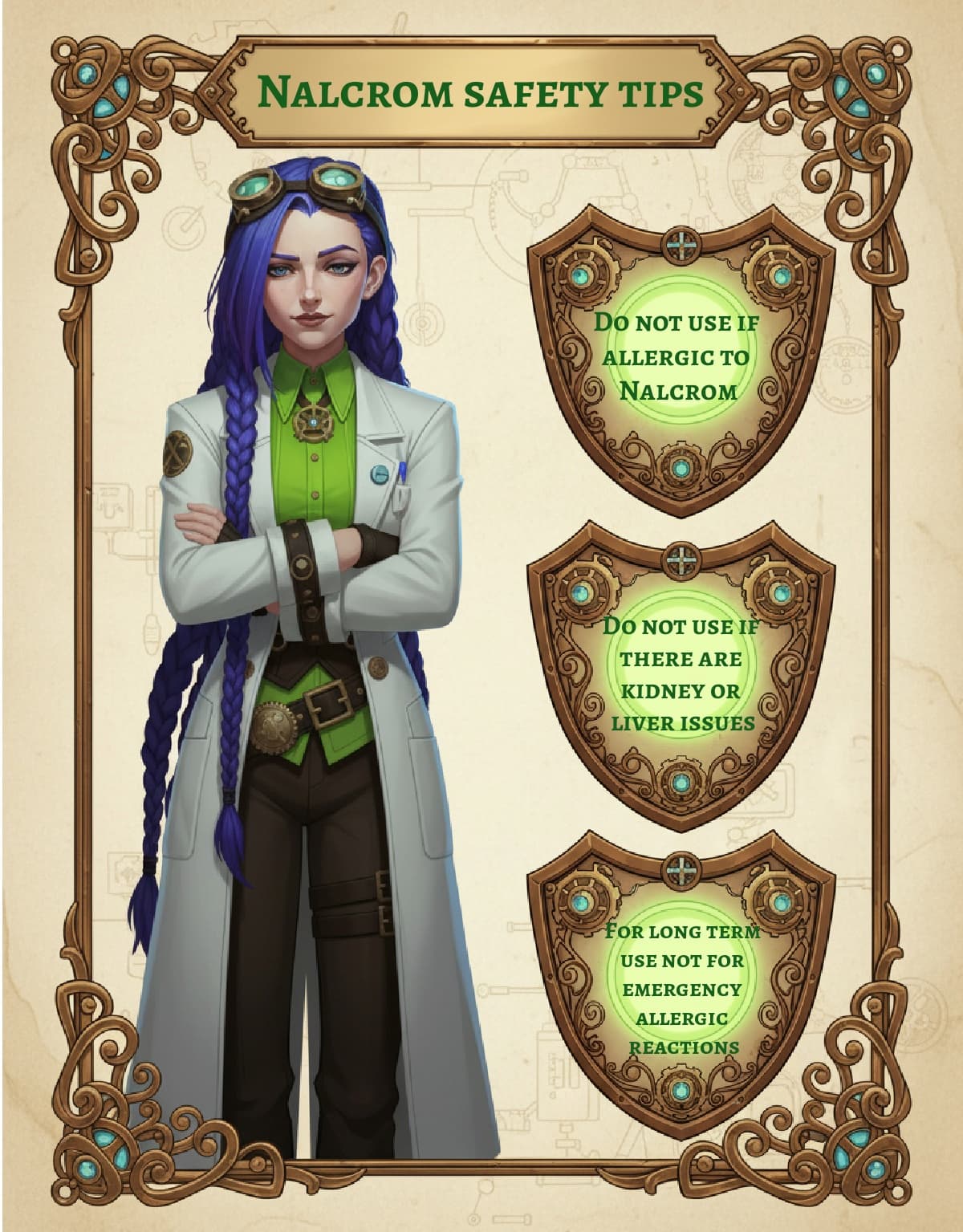
Do not take Nalcrom (sodium cromoglycate) 100mg capsule if you know you are allergic to sodium cromoglycate or any of the capsule ingredients. If you develop sudden breathing problems, swelling of the face or throat, or a severe rash after taking it, seek urgent medical help [1], [2].
Tell your doctor if you are pregnant, planning a pregnancy, or breastfeeding. Human data are limited, so clinicians weigh up the potential benefits and risks on a case by case basis [1], [2].
If you have kidney or liver problems, or other long-term health conditions, your specialist may monitor you more closely. Although sodium cromoglycate is generally well tolerated, any new medicine should be used safely in light of your overall health picture [1], [2].
Nalcrom does not replace adrenaline auto?injectors, oral steroids, or emergency plans for severe allergy. If you have been given an allergy action plan, keep following it exactly. Continue to avoid known triggers, even if your symptoms improve on Nalcrom [5].
Finally, keep regular follow-up appointments. Your clinician will want to know whether Nalcrom is helping, whether the dose needs adjusting, and whether any side effects or new symptoms have appeared.
Side effects: Nalcrom (sodium cromoglycate) 100mg capsule
Most people tolerate Nalcrom (sodium cromoglycate) 100mg capsules well. When side effects do occur, they are often mild and may resolve as your body adjusts to the medicine [1], [2].
Reported side effects include nausea, abdominal discomfort, diarrhoea, headache, joint pain, and skin rashes [1], [2]. Because many people taking Nalcrom already have gut symptoms, it can be tricky to separate what is due to the medicine and what is due to the underlying condition. Keeping a simple symptom diary can help you and your clinician spot patterns.
Very rarely, more serious reactions such as wheeze, swelling, or severe skin reactions have been reported. If you notice anything that feels severe, sudden, or worrying, stop taking the capsules and seek medical advice straight away [1], [2].
The patient information leaflet and product monograph list all known side effects and guide what to do if they occur. It is worth reading them once with a cup of tea and a highlighter, rather than only in a panic at 2am! [1], [2].
Drug interactions: Nalcrom (sodium cromoglycate) 100mg capsules
Sodium cromoglycate has relatively few documented drug interactions compared with many other medicines [1], [2]. That said, “few” is not the same as “none”, and it is still essential to give your doctor and pharmacist a complete list of everything you take.
That list should include prescription medicines, over-the-counter products, herbal remedies, and supplements. People with mast cell disorders often experiment with multiple approaches, so it is easy for combinations to creep in without anyone having the full picture.
If you start a new medicine while taking Nalcrom and notice a change in symptoms, mention it at your next review. Your clinician can check for any theoretical interactions or overlapping side effects and decide whether any adjustments are needed.
As a rule, never stop or start long-term medicines without checking first, especially if you have a complex allergy or mast cell history.
FAQ: Nalcrom (sodium cromoglycate) 100mg capsules
How quickly does Nalcrom (sodium cromoglycate) 100mg capsule start working?
Many people notice some improvement within a few days to a couple of weeks, but full benefit may take several weeks of regular use. Your specialist will usually review progress after a trial period.
Can I use Nalcrom (sodium cromoglycate) 100mg capsules for emergency allergy treatment?
No. Nalcrom is a preventative medicine. It does not work fast enough to treat sudden reactions such as anaphylaxis. Always follow your emergency allergy plan and use your prescribed rescue medicines.
Where can I buy Nalcrom or sodium cromoglycate 100mg capsules in the UK?
You can purchase Nalcrom (sodium cromoglycate) 100mg capsules in the UK after completing the MCAS consultation form at medicalmojo.co.uk.
Are Nalcrom (sodium cromoglycate) 100mg capsules safe for children?
Specialists do prescribe Nalcrom for children, often for food allergy or mast cell–related gut symptoms, but the dose is adjusted for age and weight. A paediatric allergist or gastroenterologist should supervise treatment.
Do I still need to avoid trigger foods while taking Nalcrom?
Yes. Nalcrom is not a free pass to eat known allergens. You should continue to avoid trigger foods as advised by your allergy team, and use Nalcrom as an extra layer of protection against accidental or unavoidable exposure.
Can I open Nalcrom (sodium cromoglycate) 100mg capsules?
Some leaflets allow you to open the capsules and mix the contents with a small amount of water, especially for children or adults who struggle with swallowing. Check the official patient information leaflet or ask your pharmacist before doing this.
What should I do if I miss a dose of Nalcrom?
If you forget a dose, take it as soon as you remember, unless it is nearly time for your next one. If it is close to the next dose, skip the missed dose and carry on as normal. Do not double up.</p>
How long will I
need to stay on Nalcrom (sodium cromoglycate) 100mg capsule?
Treatment length varies. Some people use Nalcrom for months, others for years. Your specialist will review your symptoms, quality of life, and any side effects to decide whether to continue, adjust, or stop.
Can I drink alcohol while taking Nalcrom?
There are no major known interactions between sodium cromoglycate and alcohol, but heavy drinking can worsen gut symptoms and interfere with allergy control. Most clinicians suggest moderation and sticking within general health guidelines.
Are Nalcrom (sodium cromoglycate) 100mg capsules the same as sodium cromoglycate eye drops or inhalers?
They contain the same active ingredient, but differ in formulation and target areas. Capsules mainly act in the gut, while eye drops and inhalers act locally on the eyes or lungs. Do not swap between them without medical advice.
Can Nalcrom help with mast cell activation syndrome (MCAS)?
Expert groups on mast cell activation disorders include sodium cromoglycate as one of the medicines that may help some people with MCAS, especially when gut symptoms are prominent. Response varies, so treatment should be individualised and supervised by a specialist.
Will I still need antihistamines if I take Nalcrom?
Often, yes. Many people use Nalcrom alongside H1 and sometimes H2 antihistamines. They work at different points in the allergic pathway, so your clinician may combine them for better control.
Can I take Nalcrom during pregnancy or breastfeeding?
Data in pregnancy and breastfeeding are limited. If you are pregnant, planning a pregnancy
Disclaimer: This article is for informational purposes only and does not replace professional medical advice.
[2] National Institute for Health and Care Excellence (NICE). 2025. Sodium cromoglicate – British National Formulary (BNF). [online] Available at:
https://bnf.nice.org.uk/drugs/sodium-cromoglicate/
[Accessed 7 September 2025].
[8] sanofi-aventis Canada Inc. PrNALCROM® Sodium Cromoglicate Capsules [Accessed: August 24, 2025]. Available from: https://pdf.hres.ca/dpd_pm/00064157.PDF.