When it comes to treating male pattern hair loss, clinicians often see the combination of dutasteride and minoxidil as one of the most powerful strategies available. This dynamic duo tackles the problem from two crucial angles: it protects the hair follicles from the hormone that causes thinning, while actively stimulating them to grow back stronger.
Right off the bat, this is one of the best combinations for tackling hair loss. Dutasteride protects your follicles from hormonal damage, while minoxidil gives them the boost they need to grow. It’s a two-pronged attack that often delivers far better results than using either treatment on its own.
Table of contents
- Five key takeaways
- The power duo for hair regrowth
- How this combination restores your hair
- A powerful synergy for hair regrowth
- What results to expect and when
- Understanding the safety and side effects
- Choosing the right treatment form
- The power of personalised medicine
- How to get dutasteride and minoxidil in the UK
- Your questions answered
- References:
-
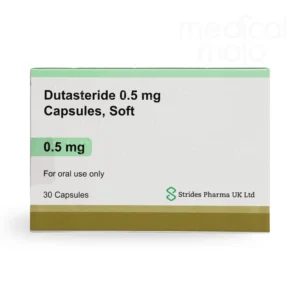
 Dutasteride 0.5mg capsulesPrice range: £22.79 through £81.99
 -
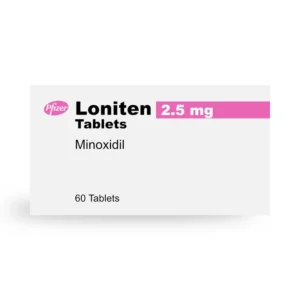
Loniten 2.5mg tablets (Minoxidil 2.5mg tablets)Price range: £39.99 through £99.99
Five key takeaways
- Two tools, two jobs: dutasteride helps protect follicles by cutting DHT (the hormone linked with male pattern hair loss), while minoxidil helps push follicles into a stronger growth phase. Used together, they cover both “stop the thinning” and “support regrowth”.
- Better odds than using one alone: the combo often performs better than dutasteride-only or minoxidil-only routines, because you’re tackling the main driver (DHT) and the growth environment at the same time.
- Expect a timeline, not a miracle: many people see early changes from 3–6 months, with clearer density gains around 6–12 months. Early shedding can happen, especially with minoxidil, and it’s often part of the reset.
- Consistency beats intensity: the best results usually come from steady use (same dose, same routine). Stopping treatment often means you slowly lose the gains over the following months.
- Safety matters and should be personalised: dutasteride can cause side effects in a small number of users, and oral vs topical choices change the risk profile. A clinician-led plan helps you pick the right format and manage issues early.
The power duo for hair regrowth
If you’re researching treatments for hair loss, you’ve almost certainly heard of dutasteride and minoxidil. Each is a respectable tool on its own, but their true potential is unlocked when they work in tandem. Think of it as a perfectly engineered system designed to keep your hair thriving.
The guardian and the engineer
Imagine your hair follicles are intricate, tiny machines. In this scenario, dutasteride acts as the Master Guardian. Its main job is to shield these delicate mechanisms from the damaging effects of a hormone called dihydrotestosterone (DHT), the primary culprit behind male pattern baldness. By blocking DHT, dutasteride prevents further thinning and helps stop the follicles from shrinking.
Minoxidil, on the other hand, plays the role of the Chief Engineer. It doesn’t deal with DHT at all. Instead, it works to boost the power supply to the follicle “machines.” Minoxidil improves blood flow and nutrient delivery, effectively turning up the power to encourage stronger growth. It helps to awaken dormant follicles and keeps them in their growth phase for longer.
This two-pronged attack is what makes the dutasteride and minoxidil combination so effective. One medicine provides powerful protection, while the other provides essential stimulation, creating the ideal environment for hair to regrow.
If you’d like to get a better handle on the basics of hair biology, feel free to explore our detailed guide on understanding your hair.
When used together, these two medicines create a synergy that often leads to far better results than using either one alone. This strategy addresses both the root hormonal cause of hair loss and the physiological need for better growth conditions.
To make things clearer, let’s break down their distinct but complementary roles.
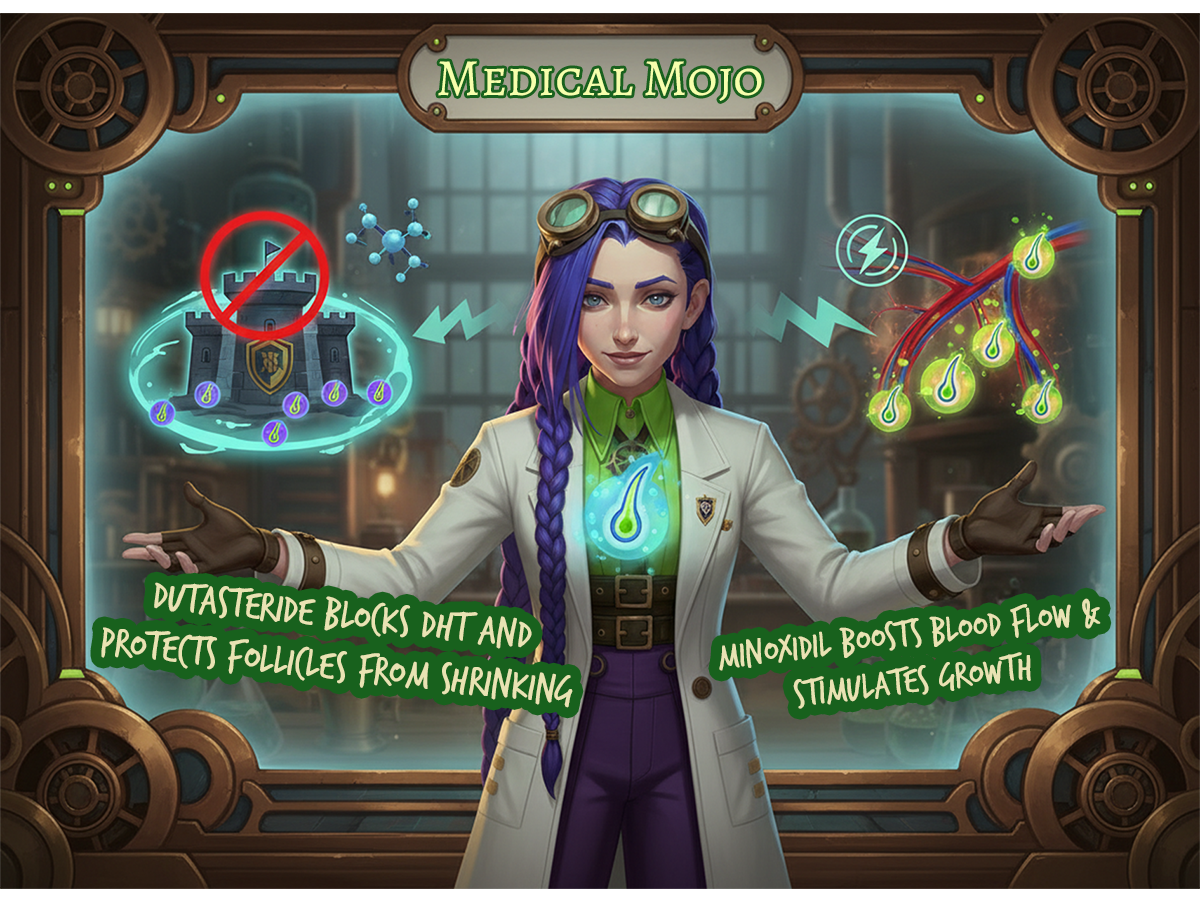
Dutasteride vs minoxidil briefly
| Feature | Dutasteride | Minoxidil |
| Primary Role | Protects follicles from DHT damage | Stimulates follicle growth and blood flow |
| Mechanism | A 5-alpha reductase inhibitor (blocks DHT) | A vasodilator (improves circulation) |
| Main Benefit | Prevents further hair loss and miniaturisation | Promotes new growth and increases hair thickness |
| Best For | Men with moderate to significant hair thinning | Anyone looking to boost hair density and growth |
Essentially, dutasteride plays defence by stopping the damage, while minoxidil goes on the offence to actively promote new, healthy growth. It’s this combined effort that gives men a real chance to not only halt their hair loss but also to see meaningful regrowth.
How this combination restores your hair
To really get why combining dutasteride and minoxidil is such a powerful strategy, you need to understand their unique but complementary roles. Think of your scalp as home to thousands of tiny hair factories, each one working to produce a single, healthy strand of hair. Over time, these factories can run into a couple of major problems that slow down or even stop production altogether.
This is where our two-pronged treatment steps in, with each medication tackling a different issue head-on.
Dutasteride: the follicle guardian
First up is dutasteride, the guardian of the factory. Its sole mission is to protect your hair follicles from their number one enemy: a hormone called dihydrotestosterone, or DHT.
In male pattern baldness, DHT is the real villain of the piece. It latches onto your hair follicles and slowly shrinks them, a process called miniaturisation. As the follicles get smaller, they can only produce finer, weaker hairs. Eventually, they give up and stop producing hair entirely.
Dutasteride is a powerful 5-alpha reductase inhibitor. This enzyme is what converts testosterone into the follicle-harming DHT. By blocking this enzyme, dutasteride drastically cuts down the amount of DHT circulating in your system, effectively disarming the primary cause of your hair loss. It acts like an impenetrable shield, safeguarding those tiny hair factories from more damage and giving them a chance to recover.
By significantly reducing DHT, dutasteride doesn’t just slow down hair loss—it creates a healthier environment that allows shrunken follicles to begin regaining their strength and vitality.
This protective action is the foundational step in reversing genetic hair loss. To explore the science in more detail, you can check out our guide on how DHT causes hair loss.
Minoxidil: the growth catalyst
While dutasteride is busy playing defence, minoxidil gets to work on the offence. It’s the catalyst that kick-starts the factory’s production line back into high gear. Originally a blood pressure medication, we now know minoxidil is a vasodilator, which simply means it helps to widen blood vessels.
When applied to the scalp or taken orally, minoxidil ramps up blood flow directly to your hair follicles. This improved circulation delivers a fresh supply of oxygen, blood, and vital nutrients right where they’re needed most.
This revitalising effect achieves two crucial things:
- It awakens dormant follicles, encouraging them to re-enter their active growth (anagen) phase.
- It prolongs this growth phase, allowing hair to grow longer, thicker, and stronger before it naturally sheds.
In short, minoxidil ensures your hair factories are well-fed and fully powered, optimising them for maximum output.
A powerful synergy for hair regrowth
Now you can see how dutasteride and minoxidil create the perfect one-two punch for hair loss. Dutasteride builds a fortress around your follicles, protecting them from DHT’s relentless assault. At the same time, minoxidil works from the inside, supercharging the follicles with the fuel they need to thrive.
The demand for this potent combination is growing. Dutasteride is often prescribed off label for hair loss because it blocks over 90% of DHT, compared to about 70% for the more widely known finasteride [1]. This has led to a rise in interest among men in their 30s and 40s.
By tackling both the hormonal cause of hair loss and the physiological need for better follicle nutrition, this combination provides a truly robust framework for not just halting hair loss but actively reversing it. One protects, the other promotes. Together, they create the ideal conditions for hair restoration.
What results to expect and when
Starting a new hair loss treatment can feel like waiting for a seed to sprout. You know you’ve done the right thing, but you’re anxious to see the first signs of life. When combining dutasteride and minoxidil, the most important thing to remember is that this is a marathon, not a sprint. The results can be fantastic, but they don’t happen overnight.
Patience is your best friend on this journey. Your hair follicles have been dormant or struggling, and it takes time for them to wake up, reset, and get back to growing properly. To give you a realistic picture, here’s a typical timeline of what to expect and when.
Months 0–3: the great reset
This initial phase can sometimes feel like one step forward and two steps back, but don’t panic—that’s completely normal. When you first start using minoxidil, it’s common to experience a temporary shedding phase. Seeing more hair in the plughole can be alarming, but it’s a positive sign.
This shedding happens because minoxidil is pushing out the old, weak hairs that were resting in the follicle, making way for new, healthier ones to grow in their place. Think of it as spring cleaning for your scalp. At the same time, dutasteride is working behind the scenes, dramatically lowering the DHT levels that were causing the hair loss in the first place. You might not see much visible change yet, but the crucial groundwork is being laid.
Months 3–6: the first signs of life
This is when things start to get exciting. The initial shedding should have calmed down, and you might begin to notice fine, soft, baby-like hairs (often called ‘vellus’ hairs) appearing in thinning areas. These are the pioneers of your new growth.
They won’t look like much at first, but their arrival is a huge milestone. It’s the proof you’ve been waiting for that the treatment is working and your follicles are responding. During this period, consistency is key. Sticking to your daily routine gives these tiny new hairs the support they need to mature and thicken.
This stage is all about celebrating the small wins. Your hair won’t be dramatically thicker just yet, but the appearance of these first new strands is a clear signal that your regrowth journey is well and truly underway.
Months 6–12: gaining ground
Welcome to the main growth phase. Between six and twelve months, those initial fine hairs should start to become thicker, darker, and longer, beginning to blend in with the rest of your hair. This is when you should see a noticeable improvement in overall density and coverage.
It’s in this window that the powerful synergy of dutasteride and minoxidil really starts to show. Dutasteride provides a protective shield against DHT, allowing minoxidil’s growth-boosting effects to work their magic without being undermined. The numbers back this up: around 81.8% of minoxidil sales are for the 5% strength, which can increase density by 25-30% in 65% of men after six months. When you add dutasteride—which saw a 22% rise in UK private clinic prescriptions from 2022-2023—the combination can boost results by as much as 50% compared to using either treatment alone [2].
If you’re curious about how this compares to other treatments, you might find our guide on how long it takes for finasteride to work useful.
12+ months: the maintenance phase
By the one-year mark, you should be able to see the full effect of the treatment. For most men, this is when hair density and coverage reach their peak potential. From here on, the goal shifts from active regrowth to simple maintenance.
Continuing with the treatment is vital to hold onto the hair you’ve gained. It’s important to remember that dutasteride and minoxidil are treatments for androgenetic alopecia, not a cure. If you stop, the DHT will return to its previous levels, and the hair you’ve regrown will likely be lost over the following months. By making it a simple part of your daily routine, you can maintain your healthier, fuller hair for the long term.

Understanding the safety and side effects
Deciding to start any new treatment always brings up questions, and it’s completely normal to think about safety and potential side effects. Being well-informed is the first step to feeling confident about the path you’re taking. Here at Medical Mojo, we believe in having open and honest conversations, so let’s walk through the safety profile of combining dutasteride and minoxidil with clarity and care.
It’s worth remembering that while side effects are possible, most people tolerate these medications well, especially when guided by a clinician. Knowing what to look out for simply puts you back in the driver’s seat of your health journey.
Potential side effects of dutasteride
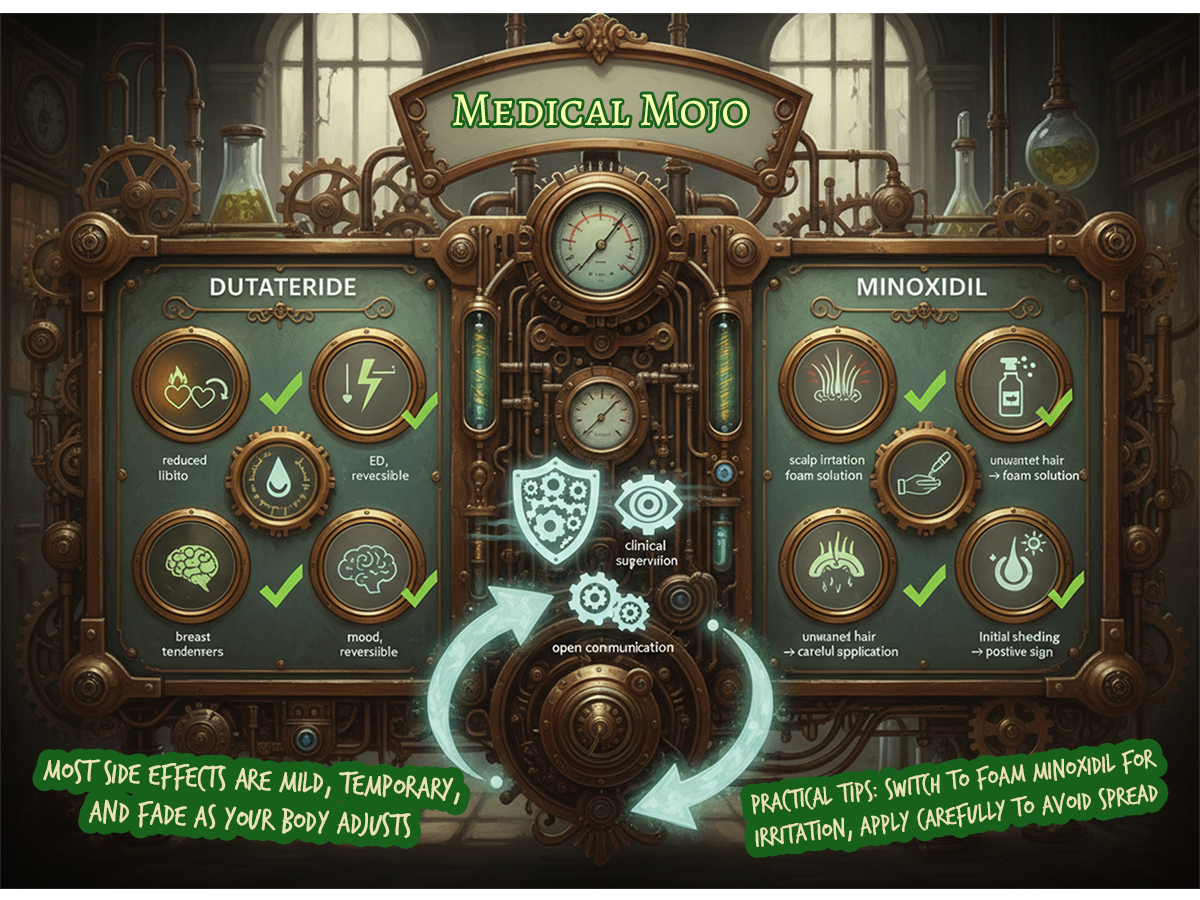
Dutasteride works by tweaking your hormonal balance to shield your hair follicles from DHT. For a small number of men, this shift can lead to certain side effects. The good news is they are typically mild and often fade away on their own as your body gets used to the medication.
The most talked-about side effects are sexual in nature. Both research and real-world clinical experience show that these only affect a small minority of users. For a deeper look at how the drug actually works, our guide explains in detail what dutasteride is and its primary mechanisms.
The side effects that are sometimes reported include:
- Reduced libido (a dip in your interest in sex)
- Erectile dysfunction (trouble getting or maintaining an erection)
- A decrease in semen volume
Less often, some men might notice changes in mood or some tenderness in the breast area. The crucial takeaway here is that in most cases, these effects are reversible and will stop if the treatment is discontinued.
Your well-being is always the top priority. If you experience any side effects that worry you, the best thing to do is speak directly with your clinician. They can offer advice, perhaps adjust your dose, or discuss other strategies to make sure your treatment is both effective and comfortable for you.
Potential side effects of minoxidil
Minoxidil is generally very well-tolerated, especially when you’re using the topical version. Any side effects are usually confined to the area where it’s applied and are rarely anything serious.
When using topical minoxidil (the liquid or foam), you might notice:
- Scalp irritation, like a bit of redness, dryness, or itchiness. This is the most common issue by far.
- Unwanted hair growth on other spots (like your forehead or cheeks) if the solution accidentally drips or spreads.
- An initial, temporary increase in hair shedding right when you first start. This is often a sign it’s working.
For the small number of people taking oral minoxidil, the side effects can be a bit different because the medication works throughout the body. These might include things like fluid retention or a faster heart rate, which is exactly why starting on a low dose under medical supervision is so important.
Practical tips for managing side effects
The great thing is that many of the common side effects are easy to manage with a few practical tweaks. This proactive approach means you can carry on with your hair regrowth journey with minimal fuss.
Here are a few simple tips that can help:
- For scalp irritation: If you find the liquid minoxidil solution is causing irritation, switching to the foam version often solves the problem instantly. The foam is made without propylene glycol, which is the ingredient most often responsible for skin reactions.
- For unwanted hair: Just be a bit careful during application. Apply the treatment right onto your scalp and give your hands a good wash afterwards. Also, make sure your hair is dry before you hit the pillow to stop it from spreading.
- For dutasteride concerns: Taking your pill at the same time each day helps your body keep a steady level of the medication. But most importantly, keep that line of communication open with your prescriber. Or get a compounded topical dutasteride solution to reduce systemic side effects.
Starting treatment for hair loss with dutasteride and minoxidil is a big step, and having a clinical team like Medical Mojo on your side can make all the difference. Regular check-ins allow us to keep an eye on your progress, help manage any side effects that might pop up, and fine-tune your treatment plan so it fits you perfectly.
Choosing the right treatment form
Stepping into the world of hair loss treatment can feel a bit like visiting an old-fashioned apothecary. You’re faced with an array of potions, pills, and concoctions, each promising remarkable results.
When it comes to the powerful duo of dutasteride and minoxidil, understanding the different forms they come in is the key to finding what truly fits your lifestyle and your scalp. After all, the best treatment isn’t just about what works in a lab—it’s about what you’ll use, day in and day out.
Let’s break down the options so you can choose your tools wisely.
Oral vs topical formulations
The first big decision you’ll face is whether to take your medication as a tablet or apply it directly to your scalp. Each method has its own clear set of advantages, and the right choice often comes down to personal preference and your specific pattern of hair loss.
Oral dutasteride and minoxidil
Taking a daily tablet is incredibly convenient. There’s no mess, no fuss, and no waiting around for a lotion to dry. Once swallowed, the medication works systemically, travelling through your bloodstream to reach every single hair follicle on your head.
This guarantees complete and even coverage, which can be a game changer if your hair loss is widespread. However, because it works throughout your body, there’s a slightly higher chance of experiencing systemic side effects. This is precisely why starting with a low dose under clinical supervision is so important. If this route sounds appealing, you can learn more about oral minoxidil tablets and how they are prescribed.
Topical solutions (lotions, foams, and sprays)
Topical treatments are applied directly where they are needed most—the scalp. This targeted approach is brilliant because it minimises the amount of medication absorbed into the rest of your body, which in turn can lower the risk of systemic side effects.
For minoxidil, you’ll typically find it as a liquid or a foam. The liquid is effective but contains propylene glycol, an ingredient that can sometimes irritate sensitive skin. The foam is a fantastic alternative, as it’s generally gentler and dries much faster.
The most significant advantage of topical treatments is the ability to combine dutasteride and minoxidil into a single, bespoke solution. A compounding pharmacy can create a personalised formula just for you, which simplifies your daily routine down to one quick application.

Choosing your formulation: oral vs topical treatments
Deciding between a pill and a topical solution can feel complicated, but it really boils down to balancing convenience, coverage, and potential side effects. The table below breaks down the key differences to help you see which approach might suit you best.
| Attribute | Oral Dutasteride | Topical Dutasteride/Minoxidil | Topical Minoxidil (Liquid/Foam) |
| Method | Daily tablet | Once or twice daily scalp application (spray/dropper) | Once or twice daily scalp application (dropper/foam) |
| Convenience | Very high – simple and mess-free. | High – combines two treatments into one application. | Moderate – requires separate application from dutasteride. |
| Coverage | Systemic – reaches all hair follicles evenly. | Localised – targeted application to thinning areas. | Localised – targeted application to thinning areas. |
| Systemic Side Effects | Higher potential due to whole-body absorption. | Lower potential as absorption is primarily localised. | Lower potential as absorption is primarily localised. |
| Local Side Effects | None. | Possible scalp irritation, depending on the formula. | Possible scalp irritation, especially with liquid form. |
| Best For | Widespread (diffuse) hair loss; individuals who prefer a simple routine. | Those wanting a powerful, convenient, all-in-one topical solution. | Those starting treatment or using minoxidil alongside an oral DHT blocker. |
Ultimately, there’s no single “best” option—only the best option for you. A discussion with a clinician can help weigh these factors against your personal health profile and treatment goals.
The power of personalised medicine
This brings us to one of the most practical advances in modern hair loss treatment: compounded medicines. Instead of juggling a pill and a separate lotion, a specialist pharmacy can combine both dutasteride and minoxidil into one easy-to-use topical spray or solution.
This approach offers several key benefits:
- Convenience: A single application is far simpler than two separate steps, making you more likely to stick with the treatment consistently.
- Precision: The strength of each active ingredient can be adjusted to match your specific needs and sensitivity.
- Reduced Side Effects: By keeping the treatment localised to the scalp, you can significantly lower the risk of systemic effects.
How to get dutasteride and minoxidil in the UK
Deciding to tackle hair loss with a heavy-hitting combination like dutasteride and minoxidil is a great first step. The next question is a practical one: how do you actually get them, safely and legally, here in the UK?
Thankfully, it’s far more straightforward than you might imagine. You essentially have a couple of paths you can take.
Navigating your treatment options
Your journey can start in one of two places: the NHS or the private sector. While your GP is always an excellent first port of call for any health concerns, hair loss treatments aren’t typically prescribed on the NHS because they are seen as a cosmetic issue.
This often means you could face long waiting lists just to see a specialist dermatologist. For many, that’s a frustrating delay when you’re keen to get started.
This is exactly where private digital health services like Medical Mojo come in. We’ve built a modern, discreet, and fully regulated way to access effective treatments without the long wait. Our whole approach is about putting you in control, with expert clinical care delivered from the comfort of your own home.
The main difference really comes down to speed, convenience, and a more personalised approach. While the NHS route can be slow, private online services are built to provide swift, expert-led access to the treatments you need, when you need them.
The Medical Mojo pathway
We’ve designed our process to be as simple and stress-free as possible, without ever compromising on clinical safety. Think of it as having a specialist hair loss clinic right on your laptop or phone.
Here’s a quick look at the steps involved:
- Start with an online consultation: You’ll begin by completing a secure and confidential online questionnaire. This covers your medical history, your hair loss journey so far, and what you’re hoping to achieve. It’s a thorough check, making sure we have all the information needed to make a safe prescribing decision.
- Review by a GPhC-registered pharmacist: Your completed form is then carefully reviewed by one of our UK-qualified, General Pharmaceutical Council (GPhC) registered pharmacists. They are experts in these medications and will assess your suitability for treatment with dutasteride and minoxidil.
- Receive your personalised treatment plan: If the treatment is a good fit for you, your prescriber will approve your personalised plan. This might involve licensed medications or, in many cases, a bespoke compounded solution that combines both dutasteride and minoxidil into one simple topical spray.
- Discreet delivery to your door: Once approved, your treatment is sent out from our registered UK pharmacy in plain, discreet packaging and delivered directly to your door.
This whole process is fully regulated, completely secure, and built to give you total peace of mind. By choosing a registered online pharmacy like Medical Mojo, you can be confident you’re getting legitimate, high-quality medication under the watchful eye of qualified UK healthcare professionals. It’s a modern way of doing healthcare, built around you.
Your questions answered
When you’re starting a new hair loss treatment, it’s only natural to have a few questions. Let’s walk through some of the most common queries we hear about using dutasteride and minoxidil together.
How long until I see results?
Patience really is a virtue here. While some people might spot subtle changes within three or four months, it typically takes a good 6 to 12 months of consistent use to see noticeable improvements in hair density and thickness.
Don’t be alarmed if you experience some shedding in the first few months. It can feel like a step backwards, but it’s often a great sign. The treatment is pushing out the old, weaker hairs to clear the way for new, healthier ones to grow in their place. The absolute key to getting the best results is sticking with it every single day.
Can women use this combination?
This is a really important point. Minoxidil is widely used and considered safe for women dealing with hair loss, but dutasteride is a different kettle of fish.
Dutasteride is generally not recommended for women who are or could become pregnant because of the potential risks it poses to a developing male foetus. That said, a specialist clinician might consider prescribing it for post-menopausal women in certain cases. Any woman experiencing hair loss should have a thorough chat with a qualified doctor to figure out the safest and most effective path forward for them.
What happens if I stop taking it?
It helps to think of these treatments as managing a chronic condition, rather than a one-off cure. The combination of dutasteride and minoxidil works hard to shield your hair follicles from DHT and stimulate new growth, but this effect only lasts as long as you’re taking the medication.
If you stop, the protective shield against DHT drops, and the growth signals fade. Sadly, this means any hair you’ve gained or maintained will likely be lost over the next three to six months. Committing to the treatment is a long-term strategy for keeping your hair.
Think of it like watering a plant. You can’t just water it for six months and expect it to thrive forever. Consistent care is what keeps it healthy and growing strong.
Are the side effects of dutasteride permanent?
This is a common and completely understandable worry. For most men, any side effects from dutasteride are reversible and will clear up after they stop the medication.
While you may read about persistent side effects online, these cases are considered very rare in clinical practice. The most crucial thing is to maintain an open and honest dialogue with your prescriber about any concerns you have. Regular check-ins and monitoring ensure your treatment plan stays both safe and effective for you.
-
Dutasteride 0.5mg capsulesPrice range: £22.79 through £81.99
-
Loniten 2.5mg tablets (Minoxidil 2.5mg tablets)Price range: £39.99 through £99.99
Disclaimer: This article is for informational purposes only and does not constitute medical advice. Always consult with a qualified healthcare professional before starting any new treatment.
References:
- Richard V. Clark et al (2004 ) ,Available at : Marked Suppression of Dihydrotestosterone in Men with Benign Prostatic Hyperplasia by Dutasteride, a Dual 5?-Reductase Inhibitor | The Journal of Clinical Endocrinology & Metabolism | Oxford Academic
- Mahmoud Nasr Abu Obeid et al ( 2024 ) Available at: Comparison between Topical Minoxidil 5% Alone versus Combined with Dutasteride (Topical 0.02% through Microneedling or Oral 0.5 mg) in Treatment of Androgenetic Alopecia | QJM: An International Journal of Medicine | Oxford Academic