

Anal fissures can feel like they come out of nowhere. One day you’re fine, the next you’re wincing every time you sit down. In this blog, we’ll walk through the most common triggers, why fissures often form in the same spot, and the key body mechanics behind the pain–spasm cycle. We’ll also explain why treatments focus so much on relaxing the internal anal sphincter and improving blood flow.[1] [2]
Table of contents
- Key takeaways
- Why an anal fissure can start with a hard stool
- When loose stools (or “nothing at all”) can trigger an anal fissure
- Opiate painkillers and anal fissure risk
- The “tear theory” vs the “blood flow theory” (and why both can be true)
- Pathophysiology: why an anal fissure may behave like an ischaemic ulcer
- Why most anal fissures occur in the posterior midline
- The pain–spasm cycle: why it hurts so much (and keeps hurting)
- Why do treatments focus on relaxing the internal anal sphincter
- Nitric oxide: the “relax” signal your sphincter may be missing
- The bottom line: what causes an anal fissure?
- References
-
Product on sale
 Rectogesic 4 mg/g Rectal OintmentOriginal price was: £69.99.£64.99Current price is: £64.99.
Key takeaways
- A hard, bulky stool can trigger an anal fissure, but many people aren’t constipated when symptoms start.[3]
- Some fissures start after loose stools or happen with no clear trigger at all.[6]
- Many experts think chronic anal fissure behaves more like a small ischaemic ulcer than a simple “tear”.[1] [4]
- Poor blood flow in the posterior midline of the anal canal helps explain why over 90% of fissures occur there.[4] [5]
- Treatments aim to reduce internal sphincter spasm, improve local blood flow, and ease pain (with surgery as a later option for persistent cases).[3] [7]
Why an anal fissure can start with a hard stool
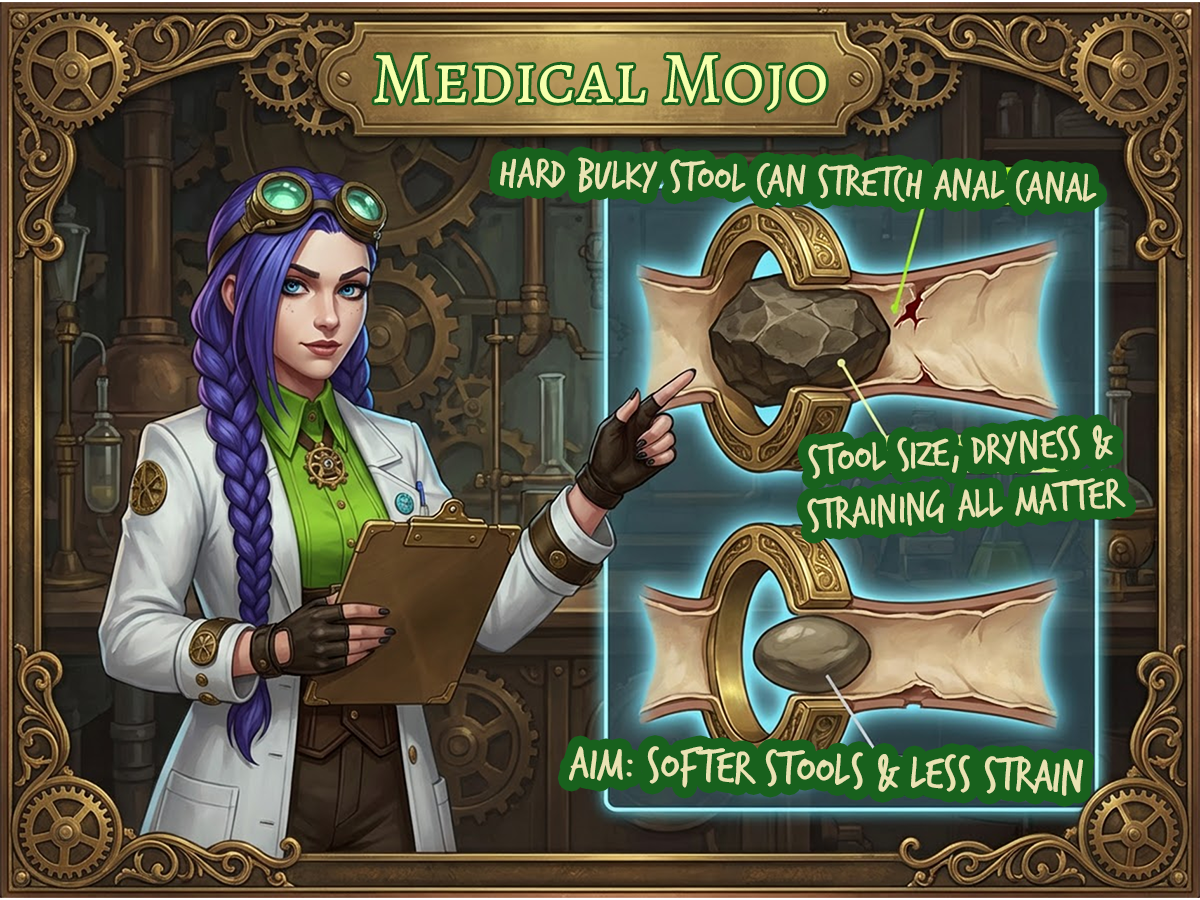
The classic story is simple: you pass a hard, bulky stool, it stretches the anal canal, and the delicate skin splits. That can absolutely happen, and it’s still one of the most common triggers people remember.
But here’s the twist. When researchers and clinicians look at real patient histories, only a minority of people are actually constipated right at the start.[6] Some people develop symptoms during a bout of loose stools. Others can’t point to any obvious trigger at all.
So yes, hard stools matter. But they’re not the whole story. If they were, every constipated person would get an anal fissure, and they don’t.
When loose stools (or “nothing at all”) can trigger an anal fissure
Loose stool can irritate the anal lining, leading to increased wiping, increased moisture, and inflammation. That can make the area more fragile. In some people, that’s enough to start an anal fissure.
And sometimes anal fissures seem to happen “spontaneously”. That doesn’t mean your body is being dramatic for fun. It usually means the underlying conditions were already there (like reduced blood flow or higher resting sphincter pressure), and a small trigger was enough to tip things over.[1] [5]

Opiate painkillers and anal fissure risk
Opiate (opioid) painkillers are well known for causing constipation. When stools become harder and drier, straining increases, and that raises the chance of injury to the anal canal.
In practical terms, if someone starts an opioid for back pain, dental pain, or after an operation, and then becomes constipated, the risk of an anal fissure can go up.
If you’re taking opioids, it’s worth being proactive with hydration, fibre, and (if appropriate) a stool softener plan agreed with a clinician. Prevention here is genuinely easier than cure.
The “tear theory” vs the “blood flow theory” (and why both can be true)
The traditional teaching is that hard stools can tear the anal skin near the dentate line. That’s still a useful mental model.
But alternative theories help explain why fissures can persist and why they tend to occur in the same place.
Two big ideas show up again and again in the research:
- Ischaemia (reduced blood flow) in the anterior and posterior midline of the anal canal[1] [4]
- A possible deficiency in nitric oxide signalling in the internal anal sphincter[2]
In plain English, the skin may be more likely to break down in certain areas because it gets less blood supply, and the muscle tone in the internal sphincter may be higher than it should be.
Pathophysiology: why an anal fissure may behave like an ischaemic ulcer
A chronic anal fissure is often described as more than a simple cut. Some evidence suggests it behaves like an ischaemic ulcer, meaning the tissue isn’t getting enough blood flow to repair itself properly.[1] [3]
This matters because it changes the treatment logic. If poor blood flow is part of the problem, then improving blood flow becomes part of the solution.

Why most anal fissures occur in the posterior midline
More than 90% of anal fissures occur in the posterior midline of the anal canal. That’s not random.
Cadaveric and anatomical studies have shown that circulation in this region can be relatively poor.[4] [5]
Now add internal anal sphincter spasm into the mix. When that muscle is tight, it can further reduce blood flow. So if a small tear happens, the area may struggle to heal. Or the skin may break down with minimal trauma and then fail to repair itself properly.[6]
That combination—fragile area, reduced blood flow, and spasm—helps explain why fissures can become chronic.
The pain–spasm cycle: why it hurts so much (and keeps hurting)
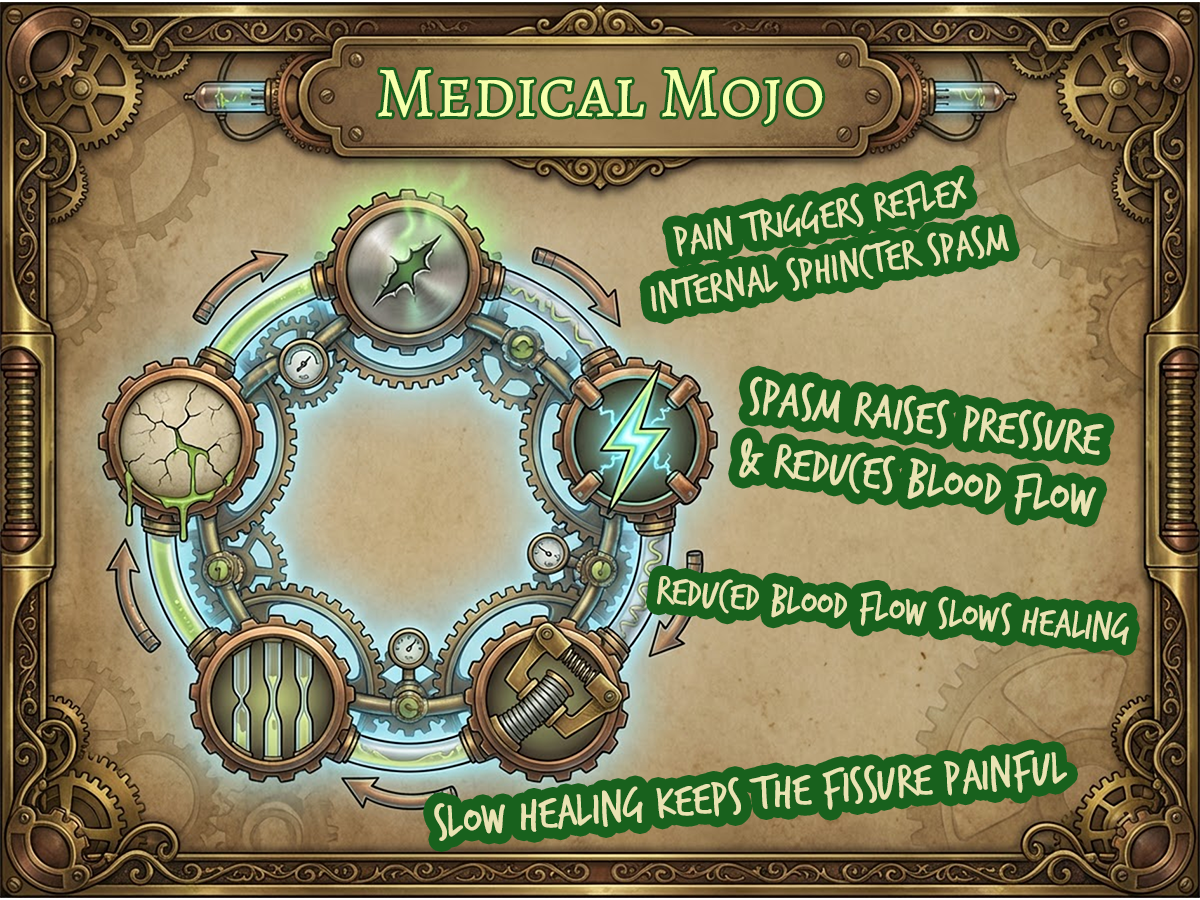
Here’s the loop many people get stuck in:
- A fissure causes pain during and after a bowel movement
- Pain triggers reflex tightening (spasm) of the internal anal sphincter
- Spasm increases resting pressure and reduces local blood flow
- Reduced blood flow slows healing
- The fissure persists, so the pain continues
It’s a nasty cycle, and it’s why fissures can feel like they’re “stuck” even when you’re doing all the right things.
Why do treatments focus on relaxing the internal anal sphincter
Because spasm is such a key part of the problem, most treatments aim to reduce internal anal sphincter tone. When resting pressure drops, blood flow improves, pain often eases, and the tissue has a better chance to recover.[3] [8]
There are a few main approaches:
- Organic nitrate ointments (like glyceryl trinitrate, also known as Rectogesic) to lower resting pressure and improve pain[7]
- Calcium channel blockers (topical) to relax smooth muscle and reduce pressure[8]
- Botulinum toxin injections to reduce sphincter spasm[8]
- Surgery (usually lateral internal sphincterotomy) for persistent fissures that don’t respond to medical therapy[3]
Nitric oxide: the “relax” signal your sphincter may be missing
Nitric oxide (NO) is one of the body’s natural “relax” signals for smooth muscle. Research has suggested that people with chronic anal fissure may have reduced nitric oxide synthase activity in the internal anal sphincter.[2]
That’s one reason nitrate ointments, like Rectogesic ointment, can help: they donate nitric oxide, which can lower anal resting pressure and reduce pain on defecation.[7]
Healing rates vary across studies and treatments, and outcomes depend on whether the fissure is acute or chronic and on how well stool consistency is managed.[8]

The bottom line: what causes an anal fissure?
An anal fissure can start with a hard stool, but it doesn’t have to. Many people aren’t constipated when symptoms begin. Some have loose stools, and some can’t identify a trigger.
What seems to matter most—especially in chronic fissure—is the environment in the anal canal: local blood flow, internal sphincter tone, and whether the tissue can repair itself after even minor trauma.[1] [5]
If you’re dealing with fissure symptoms, the goal is usually twofold: keep stools soft and reduce sphincter spasm. That’s the combination that gives the tissue the best chance to settle.
-
Product on saleRectogesic 4 mg/g Rectal OintmentOriginal price was: £69.99.£64.99Current price is: £64.99.
Disclaimer: This article is for informational purposes only and is not a substitute for professional medical advice. Always speak to a qualified clinician or pharmacist before starting, stopping, or changing treatment.
References
[1] Schouten, W.R., Briel, J.W., Auwerda, J.J. et al. (1996) ‘Ischaemic nature of anal fissure’, British Journal of Surgery, 83(1), pp. 63–65. Available at: https://doi.org/10.1002/bjs.1800830115 (Accessed: 18 February 2026).
[2] Lund, J.N. (2006) ‘Nitric oxide deficiency in the internal anal sphincter of patients with chronic anal fissure’, International Journal of Colorectal Disease, 21, pp. 673–675. Available at: https://doi.org/10.1007/s003840050115 (Accessed: 18 February 2026).
[3] Cross, K.L., Massey, E.J., Fowler, A.L. et al. (2008) ‘The management of anal fissure: ACPGBI position statement’, Colorectal Disease, 10(Suppl 3), pp. 1–7. Available at: https://onlinelibrary.wiley.com/doi/10.1111/j.1463-1318.2008.01682.x (Accessed: 18 February 2026).
[4] Klosterhalfen, B., Vogel, P., Rixen, H. et al. (1989) ‘Topography of the inferior rectal artery: a possible cause of chronic, primary anal fissure’, Diseases of the Colon & Rectum, 32, pp. 43–52. Available at: https://pubmed.ncbi.nlm.nih.gov/2912586/ (Accessed: 18 February 2026).
[5] Lund, J.N., Binch, C., McGrath, J. et al. (1999) ‘Topographical distribution of blood supply to the anal canal’, British Journal of Surgery, 86, pp. 496–498. Available at: https://pubmed.ncbi.nlm.nih.gov/10201747/ (Accessed: 18 February 2026).
[6] Lu, Y., Kwaan, M.R. and Lin, A.Y. (2021) ‘Diagnosis and treatment of anal fissures in 2021’, JAMA, 325(7), pp. 688–689. Available at: https://jamanetwork.com/journals/jama/article-abstract/2776405 (Accessed: 18 February 2026).
[7] Lund, J.N. and Scholefield, J.H. (1997) ‘A randomised, prospective, double-blind, placebo-controlled trial of glyceryl trinitrate ointment in treatment of anal fissure’, The Lancet, 349(9044), pp. 11–14. Available at: https://doi.org/10.1016/S0140-6736(96)07011-3 (Accessed: 18 February 2026).
[8] Nelson, R.L., Thomas, K., Morgan, J. et al. (2012) ‘Non-surgical therapy for anal fissure’, Cochrane Database of Systematic Reviews, (2), CD003431. Available at: https://doi.org/10.1002/14651858.CD003431.pub3 (Accessed: 18 February 2026).